Most businesses using AI for social media content are getting technically correct output. Clean sentences. Appropriate tone. Captions that tick every box and disappear into the feed without a trace.
The problem isn’t the prompt. It’s what … or isn’t … loaded behind it.
Same Prompt. Three Completely Different Results.
I demonstrated this recently in the video above using a fictional bakery announcing its fall menu. The prompt was identical across all three versions. What changed each time was the context I loaded before running it.
Version one: just the menu uploaded, nothing else. The output was what you’d expect — clean, competent, forgettable. It closed with: “Visit us soon and taste the season while it lasts.” There is nothing wrong with that sentence. It’s also what every other business announcing a seasonal menu sounds like.
Version two: a business profile added — some background on the bakery, a little context about the owner. The output got better. More specific. More sensory. Most people stop here because it feels like real progress.
It is progress. Just not enough.
Version three: a full brand voice guide loaded in alongside the same prompt. That’s where the output became: “The bakery smelled like cinnamon brown butter before sunrise this morning.” The closing line? “Chocolate pecan probably won’t make it past lunch on Fridays. Fair warning.”
Same prompt. Same AI. One makes you feel like a customer. One makes you feel like a regular.
The Version Two Trap
This is the pattern I keep seeing in client work. Businesses have moved past the bare-bones prompt stage — they’re adding context, they’re being intentional. The output is better than it was six months ago. But it still feels a little… off. And they can’t quite name why.
I wrote about this pattern back in April — The Foundation AI Users Keep Skipping — and it keeps showing up in almost every content review I do.
Here’s why: better isn’t the same as yours.
When you give AI a prompt without a brand voice guide, it generates the average. The composite of every similar business that has ever announced a fall menu, launched a product, or introduced a service. It’s not bad. It’s interchangeable.
Version two gets you closer to specific. Version three gets you to unmistakable.
Most businesses are living at version two right now and wondering why the content still isn’t landing the way it should.
What a Brand Voice Guide Actually Is
It’s not your logo. It’s not your color palette. It’s not a mission statement.
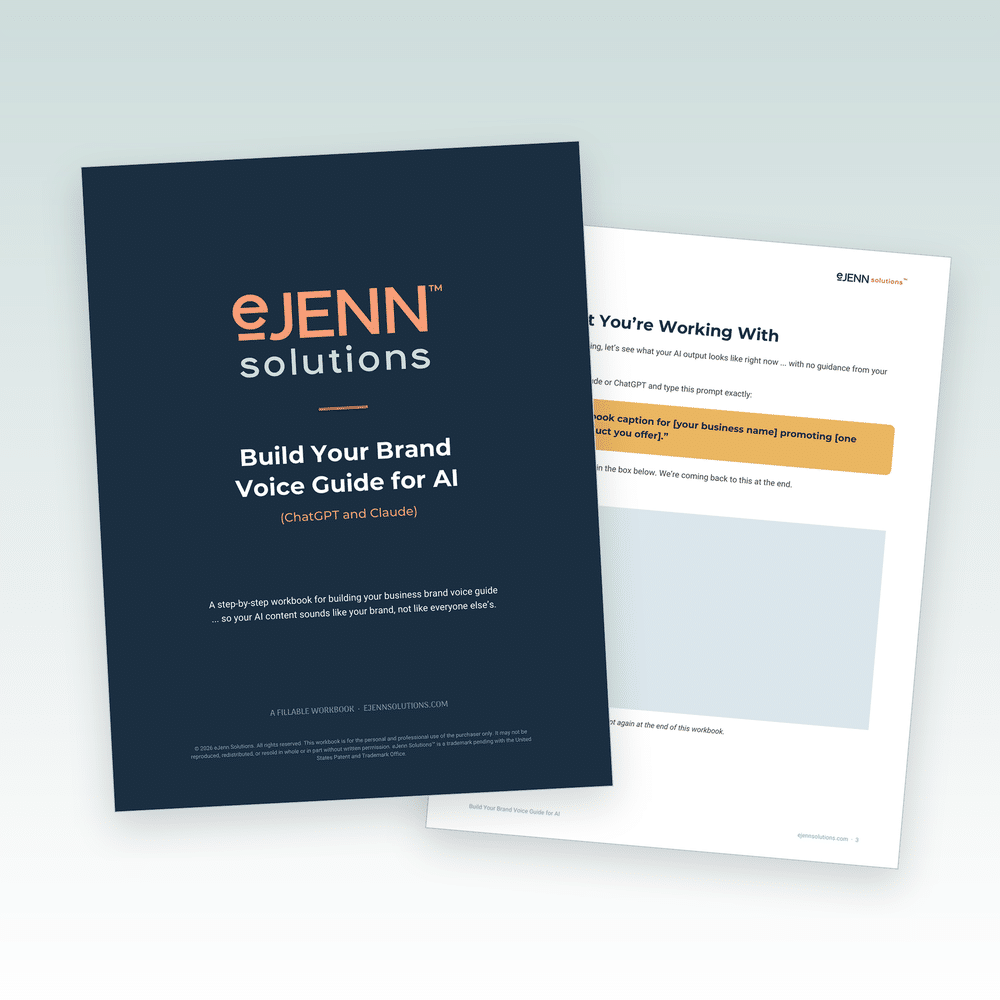
A brand voice guide is the document that tells AI how your business actually thinks and sounds — the personality behind the words, the perspective that makes your content recognizable, the specific details that separate your voice from every other business in your category.
It includes things like: how formal or conversational your tone is, the phrases that sound like you versus the ones that don’t, the kind of humor you use (or don’t), the emotional register your best content hits, the specific details from your world that make a line land.
Without it, you’re asking AI to guess who you are. And it guesses by averaging everything it’s ever seen.
With it, you’re using AI’s efficiency while keeping your own voice. That’s the version three output.
Why This Matters More Right Now
LinkedIn recently announced it’s actively suppressing generic AI content in the feed — not penalizing AI use, but targeting posts that lack original insight or perspective. The ones that could have been written by anyone, for anyone, about anything.
That’s version one and version two output. At scale.
The feeds are getting more crowded with technically functional content. Content that isn’t bad — just indistinguishable. Businesses that do the brand voice work now are going to stand out in a way that gets harder to replicate as AI use increases.
The window is open. Most people are still skipping this step.
FAQ
Does this mean I need to rewrite all my existing content?
No. It means the next thing you create should have better input behind it. Start with the brand voice guide, then let it do the work going forward.
Can’t I just describe my brand in the prompt itself?
You can, and it helps. But a dedicated brand voice guide is more thorough, more consistent, and reusable across every piece of content you create. A few sentences in a prompt is version two. A full guide is version three.
How long does a brand voice guide need to be?
Long enough to be specific, short enough to actually use. A few pages is usually enough to cover voice, tone, personality, and the kind of details that make your content feel like yours.
Is this something I build once?
Mostly yes, with occasional updates as your business evolves. The core of who you are and how you sound doesn’t change that often — which is exactly what makes it a reliable foundation for AI-assisted content.
If you want help building the brand voice layer — the piece that takes your AI output from version two to version three — that’s exactly what the eJenn audit and strategy session covers. Start here.